
What Is Anatase Titanium Dioxide (Enamel Grade)? A Comprehensive Look at Its Role in Enamel Coatings
2026-02-27
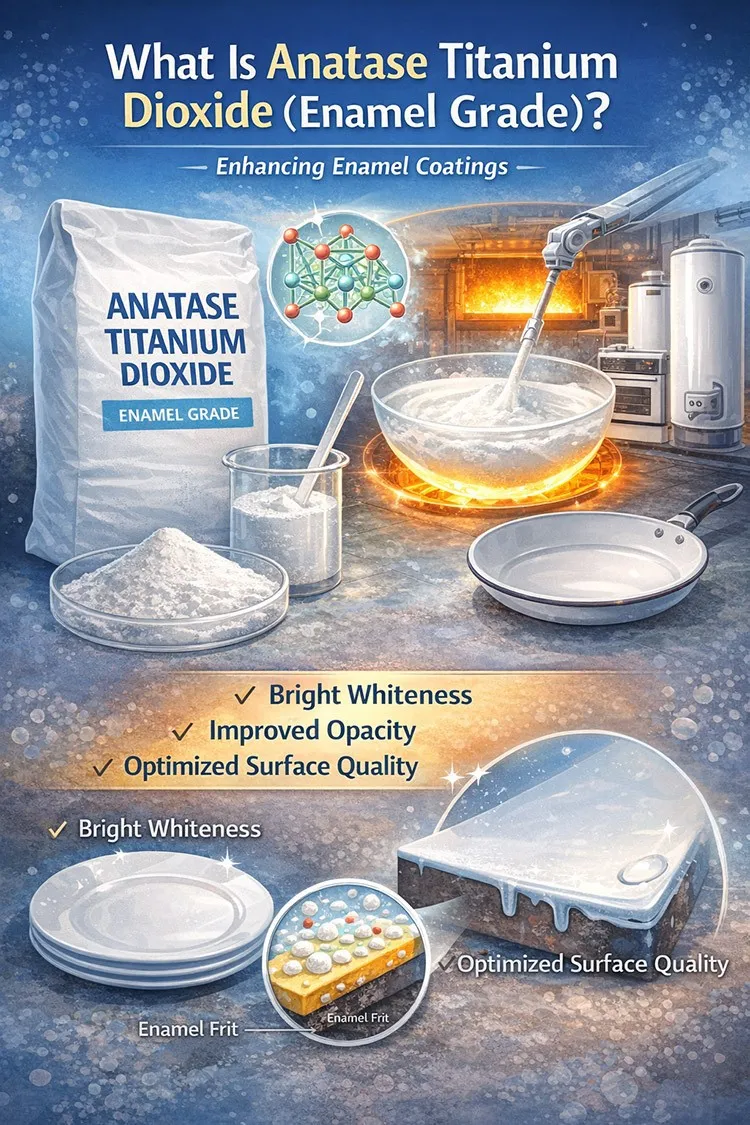
In the enamel industry, raw material selection directly impacts product appearance, durability, and production stability. Among these materials, Anatase Titanium Dioxide (Enamel Grade) has emerged as a critical functional ingredient, widely used to enhance whiteness, opacity, and overall surface quality of enamel coatings.
Unlike standard industrial-grade titanium dioxide, Anatase Titanium Dioxide (Enamel Grade) is specifically engineered for enamel frit systems. It not only delivers excellent optical properties but also withstands the high-temperature firing conditions common in enamel production, maintaining structural stability within complex coating formulations.
1. Why Do Enamel Systems Require Specialized Anatase TiO₂?
Enamel production typically involves high-temperature firing, ranging from approximately 750°C to 900°C. Under these conditions, standard titanium dioxide may face issues such as:
• Crystal structure transformation
• Poor dispersion in the frit
• Dulling or grayish appearance of the enamel
• Increased surface defects
Enamel-grade anatase titanium dioxide addresses these challenges through controlled particle size, low impurity content, and tailored thermal stability.
This makes it far more than just a "white filler" - it is:
A key factor in ensuring consistent enamel surface quality
2. Core Functions in Enamel Coatings
In practical formulations, Anatase Titanium Dioxide (Enamel Grade) plays several essential roles:
① Enhancing Enamel Whiteness
The anatase crystal structure provides excellent light scattering, improving reflectivity and resulting in a more uniform and brighter enamel surface.
② Improving Opacity
When applied over dark metal substrates, this material reduces substrate bleed-through, making it ideal for:
• Appliance enamel linings
• Cookware interiors
• Industrial protective coatings
③ Optimizing Enamel Structure
During firing, it contributes to microcrystalline structure formation, enhancing enamel density and producing a smoother, more refined surface.
3. Why Choose Enamel Grade Over Standard Titanium Dioxide?
A common question among formulators is:
Can standard anatase TiO₂ be used instead?
While possible in theory, it may introduce risks such as:
• Dull or uneven enamel
• Inconsistent firing results
• Increased surface defects
Enamel-grade anatase TiO₂ solves these problems through:
✔ Controlled particle size distribution
✔ Improved dispersion performance
✔ Reduced impurity levels
Ensuring consistent performance in enamel firing systems.
4. Impact on Enamel Appearance and Quality
Properly incorporating Anatase Titanium Dioxide (Enamel Grade) can significantly improve:
• Surface uniformity
• Gloss consistency
• Smoothness and fineness
For high-end appliance enamel or decorative coatings, these improvements directly enhance product market competitiveness.
5. Application Value in Modern Enamel Manufacturing
As consumer expectations for appearance quality continue to rise, the enamel industry is shifting from purely functional products toward high-quality decorative finishes.
In this context, Anatase Titanium Dioxide (Enamel Grade) is no longer a basic filler - it has become:
A key additive for enhancing enamel visual quality
Common applications include:
• White enamel systems
• Colored base coatings
• High-end decorative enamel coatings
6. Future Trends
With increasing demand for precise formulations and cost optimization, enamel manufacturers are placing more emphasis on material stability and long-term consistency.
As a result, the use of Anatase Titanium Dioxide (Enamel Grade) is expanding and solidifying its role as an essential component of modern enamel coating systems.
For companies seeking to balance appearance quality and production stability, understanding the functional mechanisms of enamel-grade anatase titanium dioxide is crucial for optimizing coating formulations and improving overall product competitiveness.
In the enamel industry, raw material selection directly impacts product appearance, durability, and production stability. Among these materials, Anatase Titanium Dioxide (Enamel Grade) has emerged as a critical functional ingredient, widely used to enhance whiteness, opacity, and overall surface quality of enamel coatings.
Unlike standard industrial-grade titanium dioxide, Anatase Titanium Dioxide (Enamel Grade) is specifically engineered for enamel frit systems. It not only delivers excellent optical properties but also withstands the high-temperature firing conditions common in enamel production, maintaining structural stability within complex coating formulations.
1. Why Do Enamel Systems Require Specialized Anatase TiO₂?
Enamel production typically involves high-temperature firing, ranging from approximately 750°C to 900°C. Under these conditions, standard titanium dioxide may face issues such as:
• Crystal structure transformation
• Poor dispersion in the frit
• Dulling or grayish appearance of the enamel
• Increased surface defects
Enamel-grade anatase titanium dioxide addresses these challenges through controlled particle size, low impurity content, and tailored thermal stability.
This makes it far more than just a "white filler" - it is:
A key factor in ensuring consistent enamel surface quality
2. Core Functions in Enamel Coatings
In practical formulations, Anatase Titanium Dioxide (Enamel Grade) plays several essential roles:
① Enhancing Enamel Whiteness
The anatase crystal structure provides excellent light scattering, improving reflectivity and resulting in a more uniform and brighter enamel surface.
② Improving Opacity
When applied over dark metal substrates, this material reduces substrate bleed-through, making it ideal for:
• Appliance enamel linings
• Cookware interiors
• Industrial protective coatings
③ Optimizing Enamel Structure
During firing, it contributes to microcrystalline structure formation, enhancing enamel density and producing a smoother, more refined surface.
3. Why Choose Enamel Grade Over Standard Titanium Dioxide?
A common question among formulators is:
Can standard anatase TiO₂ be used instead?
While possible in theory, it may introduce risks such as:
• Dull or uneven enamel
• Inconsistent firing results
• Increased surface defects
Enamel-grade anatase TiO₂ solves these problems through:
✔ Controlled particle size distribution
✔ Improved dispersion performance
✔ Reduced impurity levels
Ensuring consistent performance in enamel firing systems.
4. Impact on Enamel Appearance and Quality
Properly incorporating Anatase Titanium Dioxide (Enamel Grade) can significantly improve:
• Surface uniformity
• Gloss consistency
• Smoothness and fineness
For high-end appliance enamel or decorative coatings, these improvements directly enhance product market competitiveness.
5. Application Value in Modern Enamel Manufacturing
As consumer expectations for appearance quality continue to rise, the enamel industry is shifting from purely functional products toward high-quality decorative finishes.
In this context, Anatase Titanium Dioxide (Enamel Grade) is no longer a basic filler - it has become:
A key additive for enhancing enamel visual quality
Common applications include:
• White enamel systems
• Colored base coatings
• High-end decorative enamel coatings
6. Future Trends
With increasing demand for precise formulations and cost optimization, enamel manufacturers are placing more emphasis on material stability and long-term consistency.
As a result, the use of Anatase Titanium Dioxide (Enamel Grade) is expanding and solidifying its role as an essential component of modern enamel coating systems.
For companies seeking to balance appearance quality and production stability, understanding the functional mechanisms of enamel-grade anatase titanium dioxide is crucial for optimizing coating formulations and improving overall product competitiveness.
Previous: No More Data
Related News
Navigation
Home
About Usㅤ
Products
News
Application
Contact Us
Products
Titanium Dioxide
Titanium Ore
Specialty Titanium
Functional Fillers
Copyright © 2026 Shanghai Yuejiang Titanium Chemical Manufacturer Co., Ltd.